
Mobile operations in warehouses or other industrial environments aren’t just a matter of mobile devices. They’re a full ecosystem where all of your devices, your network, mobile operating system, apps, and services need to be optimized for each area and task. This allows your workers to get things done faster, more efficiently, and more effectively.
For example, if your warehouse pickers are wasting time on extra steps, walking between workstations and warehouse aisles, or juggling multiple mobile devices, they can’t access, pick, and confirm orders as quickly as possible. And this kills your shipping and fulfillment speed and efficiency.
Similarly, if your forklift drivers have to exit the cab to scan barcodes and manage inventory, it slows them down every time. If your plant managers and teams can’t see which materials or components are on the move, whether the right items are at the right workstations, and can’t see what’s due for replenishment or what’s in process, they can’t manage production effectively.
This is why you need an ecosystem strategy to ensure that the right mobile solutions, software, networking, and configuration are in place for each area and each mobile task in your operations.
How a Mobile Ecosystem Strategy Enables Better Operational Performance
Here are a few quick examples of how you can turn a mobile ecosystem strategy into some major wins in your industrial operations.
In a forklift cab, you can deploy a vehicle-mounted tablet with a companion wireless or wired barcode scanner that easily scans barcodes at long ranges—even through shrinkwrap and when goods are high on warehouse shelves. So, your operators can scan barcodes without leaving the cab, and your tablet can be a rugged, grab-and-go Zebra device that’s mounted in the vehicle with a quick release mechanism. This allows the operator to take that device and use it for other tasks elsewhere in the warehouse, too.
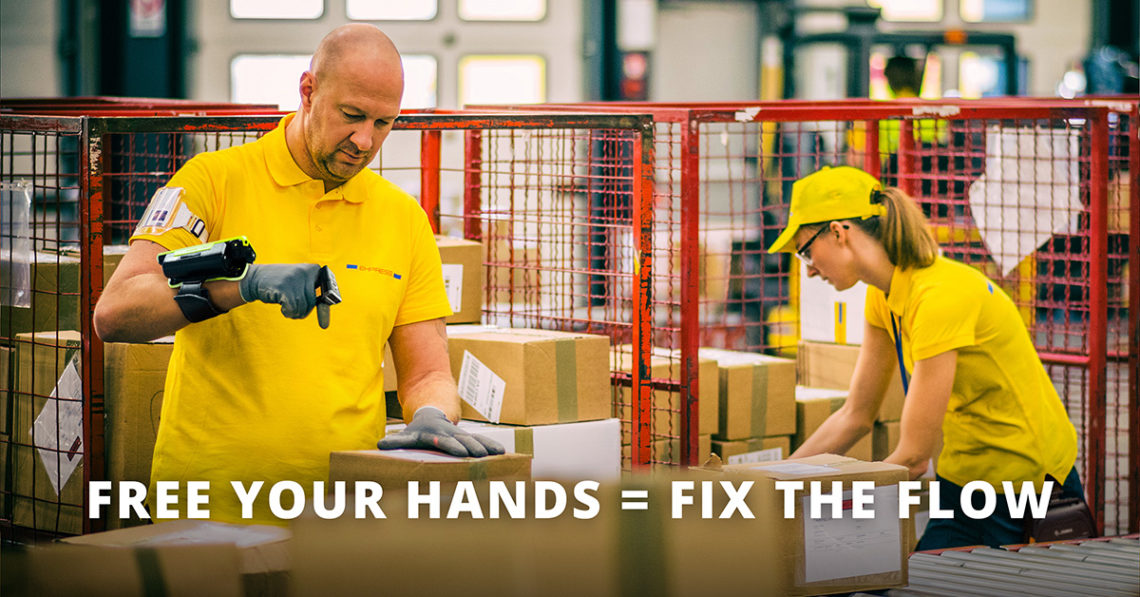
In warehouse aisles, your pickers can be equipped with wearable touch mobile computers and a wearable ring-style scanner. This way, they can easily access orders and pick lists from their wrist-worn mobile computer and scan and confirm picks with hands-free efficiency that frees them up to pick and move inventory without constantly juggling devices.
In manufacturing production, you can use a combination of handheld RFID readers and fixed-position RFID readers to wirelessly identify, locate, and track materials, components, or work in process as it moves from your warehouse to your plant floor and from station to station throughout production.
RFID lets you know what you have, what’s on the move, whether it’s the right component or build, and where it is in your processes. And it does this without you needing to perform manual scans, track things down, or request updates from key process areas.
Of course, to enable improved mobility, efficiency, and visibility, you don’t just need the right mobile devices and technologies. You need to make sure your devices, wireless network, mobile operating systems, and mobile apps are all configured and optimized for maximum performance. But that’s much easier to achieve than it sounds.
How to Build the Right Mobility Ecosystem with Managed Services
To start building a better mobile ecosystem, start with the individual tasks and workflows that team members in each area need to get done. Focus on your local ecosystems first and ensure you have the right devices, software, networking, and other mobile tools in place to optimize each specific job.
But then make sure that your local ecosystems are optimized and integrated as part of an overall mobile ecosystem that ensures the best possible performance, speed, efficiency, and tracking accuracy across your operations.
After all, you can optimize your mobility for a specific task or work area, but if the rest of your processes and workflows aren’t optimized too, or your network, apps, or other solutions are holding you back in other ways, then you’re missing the wider benefits. So, identify where you need to upgrade and improve devices, configurations, networking, and connectivity in each area and across your whole operation to get the results you need.
Often, the best way to do this is through managed services. A managed services approach means partnering with a trusted outside resource that helps you map out and determine what’s needed and then provides the mobile devices, configurations, optimization, and integration you need as part of a predictable cost and overall services contract.
So, you can consolidate hardware, networking, maintenance, management, and support through one arrangement with a predictable monthly or annual cost. There are no huge capital outlays.
Instead of taking on all of this responsibility on your own, your IT partner does it for you.
So, starting with that forklift driver, warehouse picker, or a production manager, and considering everything across your entire operations, you can:
- Assess your current mobile processes
- Review the mobile hardware you’re using for each task
- Review your related software apps and workflows
- Review your related network and business system configuration
- Determine what’s needed to improve each process
- Identify the best options for results, affordability, and return on investment
As your mobility and managed services partner works on this with you, it can:
- Recommend the right local and overall mobility ecosystems you need
- Match options to your needs, budget, and desired business outcomes
- Roll all needed hardware, software, and services into a regular, predictable cost
- Provide managed services contract options for the right fit
- Design, deploy, integrate, and support all of your solutions for you
- Work together with your IT team or resources all along the way
Also, a good provider typically has strong relationships with leading providers of technology, software, and networking solutions. So, they’re able to get solutions at a better cost and pass those savings to you through the managed services cost model.
This makes it easier and more affordable to deploy more reliable and dependable solutions from leading manufacturers who deliver an array of devices and solutions purpose-built for each task and for your mobile ecosystem overall.
For example, our team at IntegraServ works closely with Zebra as a provider of many of the solutions we deliver for our managed services clients. This allows us to procure rugged, enterprise-grade solutions such as industrial tablets, mobile computers, barcode scanners, label printers, and RFID from a single provider with an unparalleled reputation for performance and quality. It’s a great way to simplify upgrades and optimization while ensuring continuity and interoperability between mobile hardware and your operating systems, software apps, and business systems.
To learn more about how this works and get insights and recommendations from our mobile ecosystem experts at IntegraServ, reach out to us with questions and to schedule a walkthrough and consultation.
As leading providers of mobile and network solutions for over 30 years, we’re always happy to provide assessments, recommendations, case studies, and offer managed services and solutions to help you build better mobile workflows for your business. To get started, contact us now via email, visit us at IntegraServ.com, or call us at 800-233-1474.
You must be logged in to post a comment.